

PROCESSING DISCIPLINE
Processing Discipline: The Engineered Middle Pillar
In our system, processing is not a stage; it is the continuation of upstream control — the framework that connects climate-formed raw material to stable industrial supply.
Once the leaf is standardized at origin, processing is governed by a single principle: predictability must be engineered, not assumed. Every operational step from oxidation curves to structural shaping and final particle architecture is executed within defined parameters, measurable tolerances, and repeatable behavioral patterns. This removes interpretation from the line and turns processing into a controlled progression, where the role of the factory is not to alter the leaf, but to translate origin behavior into a stable industrial input.
Oxidation is carried out within predetermined boundaries; sorting functions as a structural-alignment operation, not a visual selection; and full traceability from intake to final grade links each batch to its operational fingerprint. By placing processing inside a unified architecture rather than treating it as an independent stage behavioral continuity across the chain is preserved, and the final output behaves consistently in large-scale blending systems and automated industrial lines. The result is not operator-dependent and not subject to daily variation; it is the reflection of an engineered system from origin to final grade, where upstream control is preserved and reinforced at every step.
Here, every stage from fresh leaf to final grade operates within a fully engineered, tightly controlled environment. This system combines factory science, protocol discipline, and the applied intuition of generational tea expertise to deliver not a raw product, but a reliable industrial Performance.
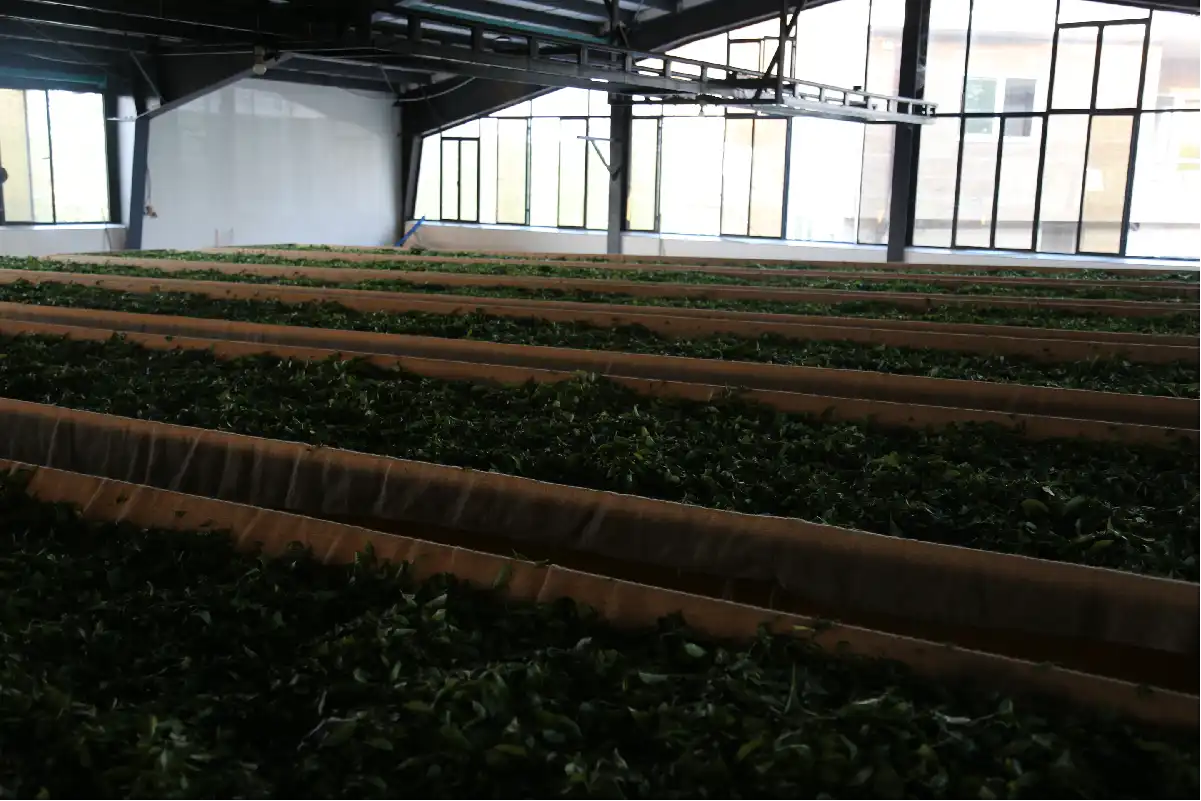
Farm and factory capacities are synchronized within a single planning program so that no day is overloaded or underfed. The farm-to-factory chain functions as one continuous system—not two separate operations—which stabilizes supply flow and ensures predictable line behavior.
At Nivan Teasun, industrial-scale supply continuity is the outcome of a cohesive upstream architecture: production volume, quality uniformity, and raw-material behavior are controlled tightly enough to support multi-year, high-volume partnerships. Pr-processing standardization and ongoing synchronization between farm and factory keeps each batch aligned with the next and maintains supply flow without interruption.
In this system, the farm is not an agricultural unit; it is the command center of the supply chain, where origin control guarantees predictability in processing. The farm operates as an engineered environment: harvesting protocols, daily data capture, structural uniformity, and quality-control checkpoints keep the entire chain under a single level of control.
Waste management and the removal of off-spec leaf occur before the material reaches the processing line, ensuring that the factory handles only qualified raw material suited for industrial performance.
The operational outcome for you is clear and measurable
A System That Produces Performance (Not a Raw Product)
At Nivan Teasun, every stage — from fresh-leaf intake to final-grade output — operates within a fully engineered and tightly controlled architecture. This architecture combines factory science, protocol discipline, and the applied intuition of generational tea makers who understand leaf behavior better than any instrument. The result is not a “product”; it is a reliable Performance — an output designed for industrial operations, stable in behavior, and consistent across every line, every batch, and every blending system.
In this model, the factory is not a transformer; it is a stabilizer — a structure that converts climate-defined leaf behavior into a predictable industrial input without distortion, fluctuation, or operator dependence.
Sorting (Behavioral Structuring)
Sorting: Structural Alignment, Not Visual Selection
At Nivan Teasun, Sorting is not a visual or cosmetic operation; it is a structural-alignment system that stabilizes particle behavior for industrial performance.
In this model, Sorting is responsible for:
Instead of evaluating shape, Sorting evaluates behavior.
This is why Sorting produces a particle profile that is:
Practically, Sorting is the first layer of Behavioral Engineering inside the factory.
Sifting (Flow Stabilization Engineering)
Sifting: Flow Stabilization & Behavioral Uniformity
At Nivan Teasun, Sifting is not a decorative or finishing step;
it is an engineered system for stabilizing flow and eliminating unwanted particle behaviors.
In this system, screen paths, deck sequencing, feed rates, and transfer velocities are engineered to minimize three critical risks:
This level of control turns Sifting into a key point in processing — a stage where:
For you, precise Sifting means: